
In This Guide
- Why Is Kitchen Remodel Cost So Hard to Pin Down in Contra Costa County?
- The 8 Factors Behind Kitchen Remodel Cost Contra Costa County Homeowners Plan Around
- How Do Refresh, Mid-Scope, and Full Remodels Compare?
- The Factor Nobody Mentions: What’s Behind Your Walls
- Refinishing, Refacing, or Replacing: Which Cabinet Path Fits?
- When Does a Full Kitchen Remodel Make Sense?
- Illustrative Project: Opening Up a Galley Kitchen in Pleasant Hill
- How Do You Keep Your Kitchen Budget Predictable?
- Frequently Asked Questions
- Is cabinet refacing the same as a kitchen remodel?
- Do I need a permit to remodel my kitchen in Contra Costa County?
- What maintenance does a new kitchen need in the first few years?
- Why do kitchen remodels go over budget?
- What affects the cost of a kitchen remodel in Contra Costa County the most?
- What should I ask a contractor before hiring them for a kitchen remodel?
- Ready to Plan Your Contra Costa Kitchen?
Direct Answer: The biggest drivers of kitchen remodel cost Contra Costa County homeowners face are layout changes, cabinet and countertop choices, electrical and plumbing upgrades required by California code, permits from your city or the county, and hidden conditions inside older homes.
If you’ve typed your kitchen size into an online cost calculator from Houzz or HomeAdvisor, you’ve probably noticed that the answers barely match each other. None of them has seen your kitchen. The kitchen remodel cost Contra Costa County homeowners actually end up with depends far more on what changes inside the room than on any regional average.
The vocabulary doesn’t help. “Remodel” and “renovation” get used as if they mean the same thing, and “refacing,” “refinishing,” and “cabinet painting” sound alike but are very different jobs. We’ve completed more than 500 kitchen remodels across the Bay Area, and these mix-ups come up in almost every first consultation.
This guide covers three things: the eight factors that push your project scope up or down, the hidden conditions that surprise owners of older homes, and how to plan so the number you sign matches the number you finish with. Want a fixed-price proposal for your own kitchen? Request a free in-home consultation or call (925) 278-8726.
Why Is Kitchen Remodel Cost So Hard to Pin Down in Contra Costa County?
Kitchen remodel cost is hard to predict because two kitchens of the same size can involve completely different amounts of work. One keeps every pipe and outlet exactly where it is. The other moves the sink to a new island, adds three circuits, and opens a wall to the dining room.
Geography adds another layer. Contra Costa County runs from older neighborhoods in Richmond and El Cerrito to newer subdivisions in Brentwood and Antioch, and the age of a house changes what a crew finds once the old cabinets come off the wall. That’s why any honest estimate of kitchen remodel cost Contra Costa County homeowners receive should start with a site visit, not a phone quote.
The 8 Factors Behind Kitchen Remodel Cost Contra Costa County Homeowners Plan Around
These eight factors explain nearly all the variation we see between kitchen projects. Some you control directly. Others are decided by your house before you ever call a contractor.
1. Kitchen Size and Footprint
Size sets the baseline in any kitchen remodel cost Contra Costa County estimate. A larger kitchen needs more cabinet boxes, more countertop surface, more flooring, and more labor hours. A compact galley in a Martinez condo and an open kitchen in a Danville single-family home start from very different places, even with identical finishes.
2. Layout Changes
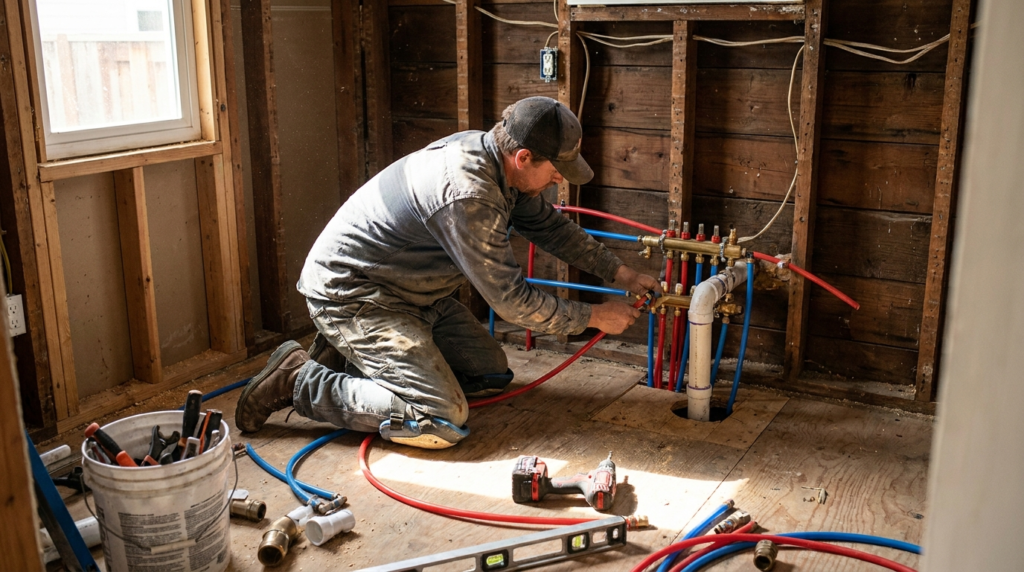
Layout is usually the single largest swing factor in kitchen remodel cost Contra Costa County projects. Keeping the sink, range, and refrigerator in place means plumbing, gas, and electrical stay where they are. Moving them means new supply lines, new drains, rerouted vents, and often new framing.
Removing a wall raises a second question: is it load-bearing? If it is, you’ll need a beam, engineering, and a building permit. Keeping the layout can shorten a project by weeks. Moving it adds trades, inspections, and time.
3. Cabinet Type and Construction
Cabinets are typically the biggest material decision in a full remodel, and they shape the kitchen remodel cost Contra Costa County homeowners see more than any other finish. Stock, semi-custom, and built-to-measure custom cabinets differ in materials, sizing flexibility, and lead time. If your existing cabinet boxes are solid, you may not need to replace them at all (more on that below).
4. Countertop Material and Fabrication
Quartz, granite, marble, quartzite, and porcelain each behave differently. Natural stone needs periodic sealing, while quartz doesn’t. Thick slabs, waterfall edges, and extra seams on a large island all add fabrication time, and every slab is templated on site only after cabinets are installed.
5. Electrical, Lighting, and Appliance Upgrades
California’s building standards require GFCI protection on kitchen countertop receptacles, dedicated circuits for major appliances, high-efficacy lighting, and mechanical exhaust ventilation. Once walls are open, the inspector expects your kitchen to meet today’s code, not the code from the year your house was built.
Appliance choices ripple into this. Switching from a gas range to induction, adding a wall oven, or installing a pro-style hood can call for a larger circuit or a full panel upgrade. In many older homes, this is where kitchen remodel cost Contra Costa County estimates shift the most, because the original panel was never sized for a modern kitchen.
6. Plumbing, Gas, and Ventilation
Plumbing work ranges from swapping a faucet to relocating a drain line across the room. A pot filler, a prep sink, or an island sink each needs new lines and an inspection. Range hoods that vent outdoors need a clear duct path, which is simple on an exterior wall and far more involved over an island.
7. Permits and Which Office Handles Them
Most kitchen remodels that touch electrical, plumbing, or walls need a building permit. Where you apply depends on your address. Incorporated cities such as Walnut Creek, Concord, and San Ramon run their own building departments, while unincorporated communities like Alamo, Discovery Bay, and El Sobrante go through Contra Costa County’s building inspection division.
Since January 1, 2026, new permits follow California’s 2025 building code cycle. Plan review, inspection scheduling, and any corrections all shape your timeline, so permits belong in every kitchen remodel cost Contra Costa County conversation from the first meeting.
8. Labor, Lead Times, and Scheduling
Labor is a real line in every kitchen remodel cost Contra Costa County proposal. Skilled trades in the Bay Area command higher rates than the national average, and Contra Costa is no exception. Lead times matter too: custom cabinets and special-order appliances can take weeks to arrive, and no crew can install what hasn’t shown up. One general contractor coordinating every trade closes the gaps that stretch projects out.
How Do Refresh, Mid-Scope, and Full Remodels Compare?
Scope is the clearest way to understand kitchen remodel cost Contra Costa County homeowners can expect, because each level brings a different mix of trades, permits, and time. The timelines below reflect what our crews typically see once construction begins.
| Scope level | What changes | Permit usually needed? | Typical construction time | Best for |
|---|---|---|---|---|
| Cosmetic refresh | Cabinet painting, refinishing, or refacing; new hardware; sometimes new counters on existing boxes | Often not, unless wiring or plumbing changes | 1 to 2 weeks for cabinet-only work | A layout that works but looks dated |
| Mid-scope remodel | New cabinets, counters, backsplash, lighting, and appliances in the same layout | Usually yes (electrical and plumbing) | 3 to 5 weeks for smaller kitchens | Worn-out cabinets with a functional footprint |
| Full remodel with layout change | Walls, plumbing, gas, and electrical relocated; new island or expanded footprint | Yes, often with engineering | 8 to 12 weeks for structural redesigns | Closed-off or inefficient kitchens you plan to keep for years |
The Factor Nobody Mentions: What’s Behind Your Walls
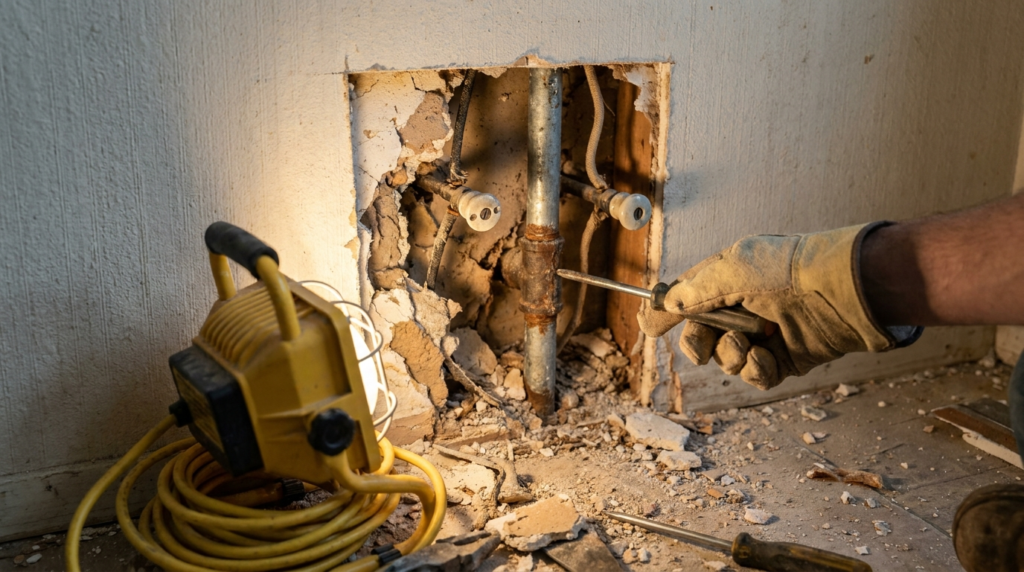
Hidden conditions inside walls, floors, and ceilings are the most common reason a kitchen project changes after demolition. Much of central Contra Costa, including large parts of Concord, Pleasant Hill, and Walnut Creek, was built in the decades after World War II, and those kitchens have had 50 or more years to collect surprises.
Here’s what our crews find most often when the old cabinets come out:
- Undersized electrical panels and outdated wiring that can’t support modern appliance loads.
- Galvanized or deteriorating supply lines hidden behind the sink base.
- Soft or rotted subfloor under dishwashers and sinks from years of slow leaks.
- Lead-based paint in homes built before 1978, which federal EPA rules require lead-safe certified renovators to handle.
- Materials that may contain asbestos, such as older sheet flooring or textured ceilings, which should be tested before demolition.
You can’t see through drywall, but you can reduce the risk:
- Ask for a pre-construction check of the panel, visible plumbing, and subfloor.
- Test suspect materials before anything gets torn out.
- Agree in writing how discovered conditions will be priced and approved.
- Choose a contractor who builds code-required upgrades into the original scope instead of adding them later.
Hidden conditions are a real part of kitchen remodel cost Contra Costa County owners of older homes should expect. Before you sign anything, ask one question: “What happens, in writing, if you find something unexpected once the walls are open?”
Refinishing, Refacing, or Replacing: Which Cabinet Path Fits?
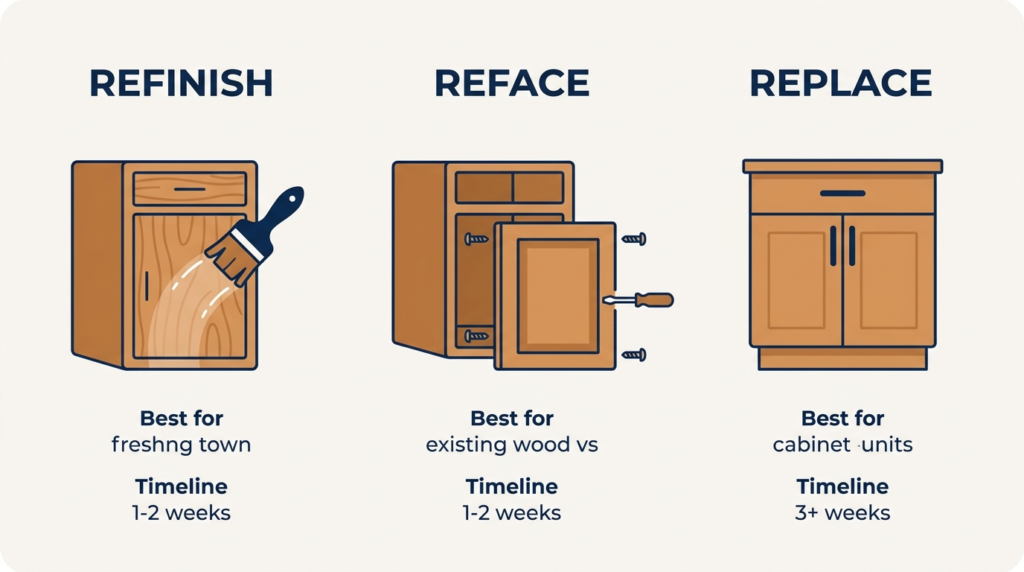
The right cabinet path depends on two things: whether your cabinet boxes are structurally sound, and whether your layout is staying put. Refinishing changes the color. Refacing changes the face. Replacement changes the whole kitchen. Picking the right path is one of the simplest ways to keep kitchen remodel cost Contra Costa County decisions grounded in what your cabinets actually need.
- Cabinet refinishing or painting: Best for solid wood cabinets whose door style you already like. Common mistake: painting over years of grease without proper degreasing and priming, which leads to early chipping around handles.
- Cabinet refacing: New doors, drawer fronts, and veneer over your existing boxes. Best when the layout works and the boxes are sturdy. Common mistake: refacing a sink base that already has water damage, which only hides the problem. Our page on cabinet refacing explains how the process works step by step.
- Full replacement with built-to-measure cabinets: Best when you’re changing the layout or the boxes are failing. Common mistake: ordering cabinets before final appliance specs are confirmed, which can leave a refrigerator or range that doesn’t fit.
When Does a Full Kitchen Remodel Make Sense?
A full kitchen remodel makes the most sense when the layout itself is the problem, not just the finishes. Picture a closed-off 1970s kitchen in Walnut Creek where you can’t see the family room from the stove, or a narrow galley in a Concord ranch home with no room for a second cook. New paint won’t fix either one.
A full remodel is also worth considering when your panel, plumbing, or ventilation is near the end of its life anyway. Since those systems will need work soon, it’s usually more efficient to address them while the walls are already open.
Matching scope to the real problem keeps kitchen remodel cost Contra Costa County planning honest. A full remodel is not always the best choice:
- Your cabinet boxes are solid and the layout already works, so refacing or refinishing gives you most of the visual change in a fraction of the time.
- You plan to sell within a year or two and only need the kitchen to show well.
- You live in a condo where HOA rules limit moving plumbing or venting through shared walls.
Our guide on custom kitchen remodeling breaks down what’s included at each stage, from layout planning to final fixture installation.
Illustrative Project: Opening Up a Galley Kitchen in Pleasant Hill
This is an illustrative example based on the kind of project we see often in central Contra Costa. It’s a composite, not a specific client.
Picture a single-story 1960s home in Pleasant Hill with a narrow galley kitchen closed off from the dining room. The owners want an island, more storage, and natural light from the dining room windows. On paper, it’s a simple wall removal.
Once the crew opens things up, three discoveries reshape the scope. Part of the wall turns out to be load-bearing, so it needs an engineered beam. The original panel can’t support the induction range and wall oven they chose, so it needs an upgrade. And a galvanized supply line behind the sink base is close to failing.
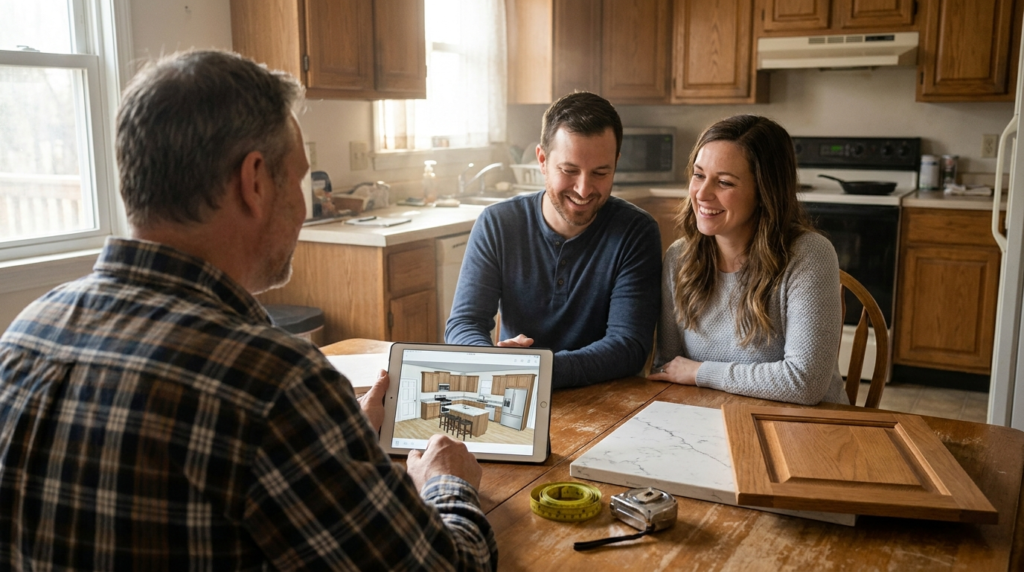
Because the 3D rendering and selections were approved before anything was ordered, the only open questions are the hidden conditions, and each one is priced and approved in writing before work continues. The permit runs through the City of Pleasant Hill, and the project lands in the 8 to 12 week range typical for a structural redesign. This is exactly how kitchen remodel cost Contra Costa County projects shift: not from the countertop color, but from what sits behind the drywall.
How Do You Keep Your Kitchen Budget Predictable?
The most reliable way to keep kitchen remodel cost Contra Costa County projects predictable is to make every big decision before demolition starts. Changes made mid-construction cost more time than the same changes made on paper.
- Decide the layout first. Staying or moving is the decision that shapes everything else.
- Finalize selections early. Cabinets, counters, appliances, and fixtures should be chosen before ordering begins.
- Get a fixed-price contract with a written scope. Every line item should be visible before you sign.
- Ask how change orders work. Nothing should be added without your written approval.
- Verify the license. You can look up any California contractor on the CSLB website. Adval Construction is licensed, bonded, and insured under CSLB #1059130.
Homeowners who’ve reviewed us on Google and Yelp tend to mention the same things: careful attention to detail, a clean jobsite, and a team that stays professional from start to finish. You can also check our BBB profile before you reach out.
Not sure which scope fits your kitchen? Schedule a free consultation and we’ll walk through your layout, your existing systems, and your goals in person.
Frequently Asked Questions
Is cabinet refacing the same as a kitchen remodel?
No. Cabinet refacing replaces the doors, drawer fronts, and exterior veneer while keeping your existing cabinet boxes and layout. A kitchen remodel usually replaces cabinets, counters, and fixtures, and may move plumbing or walls. Refacing works well when the boxes are sound and the layout already suits you.
Do I need a permit to remodel my kitchen in Contra Costa County?
You usually need a permit if the kitchen remodel touches electrical, plumbing, gas, or walls. Purely cosmetic work, such as painting cabinets or swapping hardware, often doesn’t require one. Homes in incorporated cities apply through their city’s building department, while unincorporated areas apply through Contra Costa County.
What maintenance does a new kitchen need in the first few years?
A new kitchen needs a few simple habits to stay in good shape. Natural stone counters should be resealed on the schedule your fabricator recommends, while quartz only needs routine cleaning. Cabinet hinges may need small adjustments as wood settles through seasonal humidity changes, and range hood filters should be cleaned regularly.
Why do kitchen remodels go over budget?
Kitchen remodels usually go over budget for two reasons: hidden conditions found after demolition and decisions changed mid-construction. Older homes may need panel, plumbing, or subfloor repairs nobody could see beforehand. A written process for approving changes keeps both risks under control, and it is the single best protection against kitchen remodel cost Contra Costa County surprises.
What affects the cost of a kitchen remodel in Contra Costa County the most?
Layout changes affect kitchen remodel cost Contra Costa County homeowners face more than any other factor. Moving a sink, range, or wall brings in plumbing, electrical, framing, and permit work. Cabinet construction, countertop material, code-required upgrades, and the age of your home follow close behind.
What should I ask a contractor before hiring them for a kitchen remodel?
Before hiring a kitchen remodel contractor, ask for their CSLB license number and proof of insurance. Ask whether the contract is fixed-price with a written scope, who pulls the permits, and how change orders are approved. Finally, ask to see photos of recent kitchen projects similar to yours.
Ready to Plan Your Contra Costa Kitchen?
You now know where the real swings come from: layout, cabinets, code upgrades, permits, and whatever is hiding behind your walls. The kitchen remodel cost Contra Costa County homeowners can count on comes from deciding those things early and putting them in writing. You can see more of our work across the county on our Contra Costa County service area page.
When you’re ready to talk through kitchen remodel cost Contra Costa County factors for your own home, request your free in-home consultation or call (925) 278-8726. Adval Construction Inc, 418 N Buchanan Cir Suite #7, Pacheco, CA 94553.