
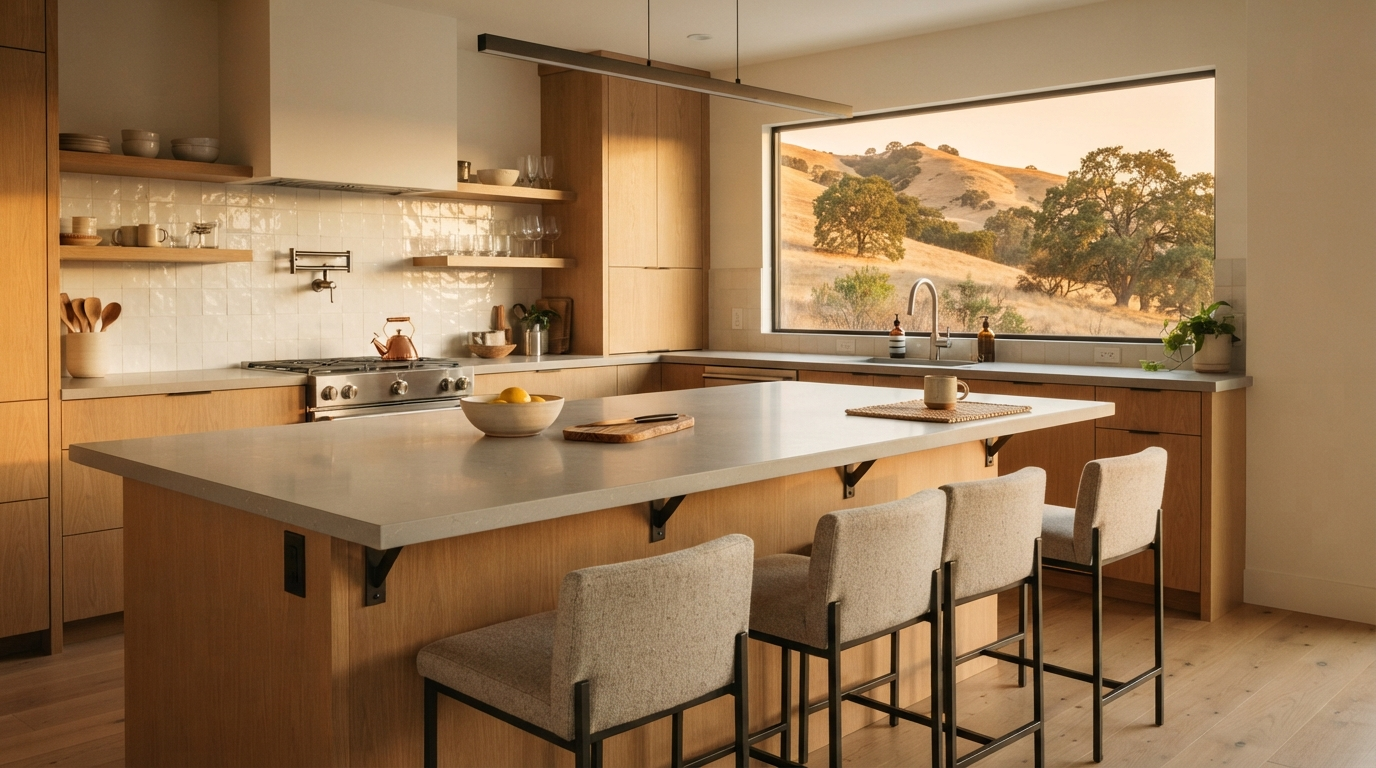
In this guide:
- Quartz vs granite countertops at a glance
- Does hard water damage quartz or granite?
- The problem nobody talks about: your house moves
- Which thickness, edge and finish should you choose?
- What changes the scope of your countertop install?
- Where each material makes sense (and when it doesn’t)
- Example project: a hard-water kitchen in Vacaville
- FAQ
- Your next step
Direct Answer: In the quartz vs granite countertops decision for a Bay Area kitchen, quartz wins on stain resistance and zero sealing, granite wins on heat and sunlight tolerance, and both last for decades only when seams, overhang support and cabinet leveling are planned correctly.
You walk into a slab yard and the labels start to blur: Caesarstone, Silestone, Cambria, “white granite,” “quartzite.” Some of those slabs are engineered quartz. Others are quarried stone. And quartzite, despite the name, is a natural metamorphic rock, not engineered quartz at all. No wonder the choice feels harder than it should.
We template and install both materials in kitchens across Contra Costa and Solano County, and the questions you probably care about aren’t really about color. They’re about what the surface looks like after five years of real cooking. This guide to quartz vs granite countertops covers three things most comparisons skip: how your local water supply affects each material, why Bay Area houses that shift need smarter seams and support, and which install details change the scope of your project.
Already have a slab in mind? You can book a free in-home consultation and we’ll bring samples so you see them under your own kitchen lighting.
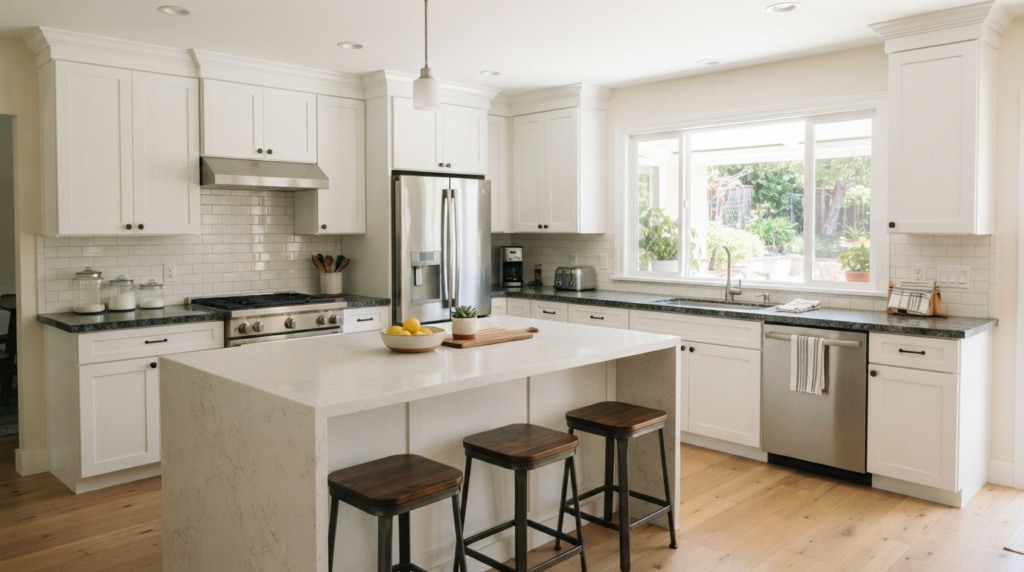
Quartz vs Granite Countertops at a Glance
Quartz is an engineered slab made mostly of crushed natural quartz (usually around 90 percent or more) bound with polymer resin, while granite is a natural igneous stone cut straight from quarried blocks. That single difference explains almost every trade-off in the table below.
The resin makes quartz non-porous and consistent from one slab to the next. It also makes quartz more sensitive to direct heat and to years of strong sunlight. Granite has no resin, so heat barely bothers it, but its tiny pores need a sealer to keep oils and minerals out.
| Factor | Quartz (engineered) | Granite (natural stone) |
|---|---|---|
| What it is | Crushed quartz bound with resin and pigments | Quarried igneous rock, cut and polished |
| Sealing | Never needed | Typically every 1 to 3 years, confirmed with a water-drop test |
| Heat from pots and pans | Use trivets; resin can scorch or discolor | Highly heat tolerant; trivets still protect the sealer |
| Long-term direct sun | Resin can fade or yellow; most makers don’t cover outdoor use | Color stays stable |
| Stain resistance | Excellent with no upkeep | Very good while the sealer is fresh |
| Pattern consistency | Predictable; matches the sample | Every slab is unique; pick your exact slab |
| Hard water spotting | Film sits on top; wipes off | Can darken worn, unsealed areas near the sink |
| Best fit | Busy households that want low maintenance | Heavy cooks and sunny kitchens |
Does Hard Water Damage Quartz or Granite?
Hard water does not structurally damage either countertop, but the calcium and magnesium it leaves behind look and behave differently on each surface. More important, how hard your water is depends on your water supplier, not on “the Bay Area” as a whole.
The differences inside our own service area are big. The East Bay Municipal Utility District (EBMUD), which serves Lafayette, Orinda, Moraga, Danville, San Ramon and much of Walnut Creek, reports hardness of roughly 1 to 7 grains per gallon across its system. In December 2025, its Lafayette and Orinda treatment plants measured about 16 to 17 mg/L, which works out to roughly 1 grain per gallon. That’s soft water.
Head out to Solano County and the numbers change. The City of Vacaville’s recent annual water quality reports show average hardness in the 160 to 180 ppm range, about 9 to 10 grains per gallon, with some groundwater samples reaching 300 ppm. Concord, Clayton and parts of Pleasant Hill and Martinez get Delta water through the Contra Costa Water District, and your annual Consumer Confidence Report lists the exact hardness figure for your address.
So before you settle the quartz vs granite countertops question based on spotting, look at your water bill, find your supplier, and check the hardness line in its yearly report. It takes five minutes.
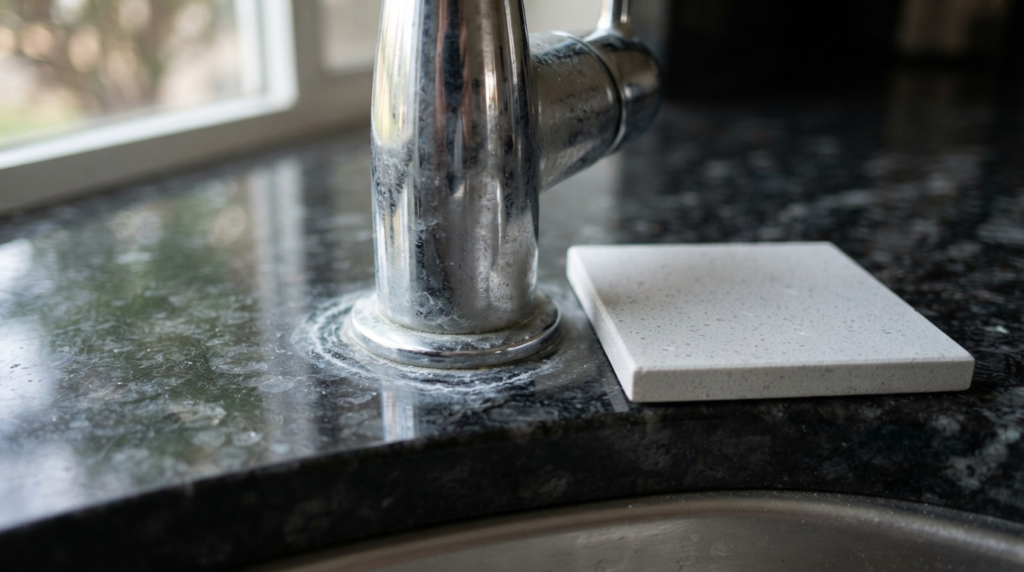
What hard water looks like on quartz
On a quartz countertop, hard water leaves a dull, chalky film that sits on top of the surface, usually in a ring around the faucet and along the sink edge. Because quartz isn’t porous, the minerals can’t soak in. A damp microfiber cloth and a pH-neutral cleaner remove most of it. Skip abrasive pads and harsh descaling products, since many quartz manufacturers warn against strong chemicals in their care guides.
What hard water looks like on granite
On a well-sealed granite countertop, hard water behaves much like it does on quartz. The trouble starts when the sealer wears thin around the sink, which is the busiest wet zone in the kitchen. Mineral-heavy water can then wick into the stone and leave darker rings or cloudy patches. Acidic descalers make it worse because they break down the sealer and can dull some polished stones.
Habits that help in hard-water kitchens
- Dry the faucet zone daily. A quick towel pass after dinner prevents most buildup on either material.
- Use a pH-neutral stone cleaner. Vinegar and lime removers are the most common cause of dull granite we see.
- Reseal granite near the sink first. That zone often needs attention before the rest of the counter does.
- Choose a forgiving color. Mid-tone and patterned surfaces hide spots far better than polished black.
The Problem Nobody Talks About: Your House Moves
The biggest threat to a stone countertop in a Bay Area home is rarely the stone. It’s movement in the structure underneath, from seasonal ground shifts to the occasional earthquake. Many East Bay lots sit on clay soils that swell when wet and shrink when dry, and older homes settle unevenly over decades.
A 3 cm slab is rigid. Your cabinets, floor and walls are not. When the house shifts, stress concentrates in the weakest spots of the countertop: seams, the narrow strips in front of and behind a sink, corners of cooktop cutouts, and overhangs without enough support. To be clear, neither option in the quartz vs granite countertops debate is “earthquake-proof,” and we won’t tell you one survives a quake better than the other. What protects either one is the support system under it.
Here’s how we reduce that risk on every install, quartz or granite:
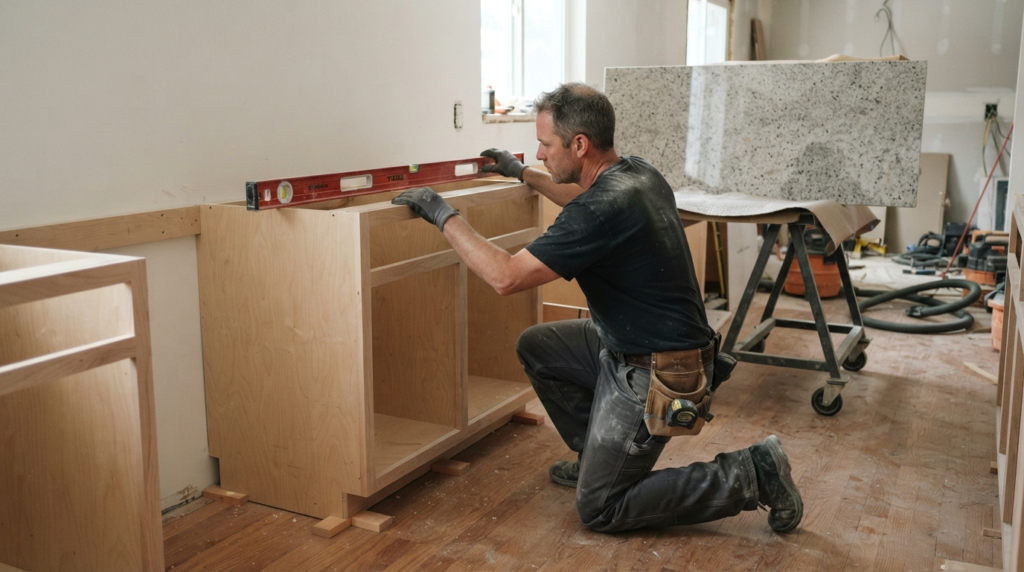
- Level and fasten the cabinets first. Boxes get shimmed level, screwed to wall studs and to each other, so the slab isn’t bridging gaps.
- Plan seams away from cutouts. A seam should land over solid cabinet support, not beside a sink or cooktop opening.
- Reinforce narrow sections. Thin rails around an undermount sink can be rodded so they don’t crack during handling or later movement.
- Support every overhang. Island and bar overhangs past the fabricator’s rated limit for that thickness get corbels or concealed steel brackets.
- Leave flexible joints at the walls. Silicone, not grout, lets the slab and the wall move a little without chipping.
Before you sign with any fabricator, ask one simple question: “Where exactly will my seams land, and what supports the overhang on this island?” A confident, specific answer tells you a lot about the crew, whichever side of quartz vs granite countertops you end up on.
Which Thickness, Edge and Finish Should You Choose?
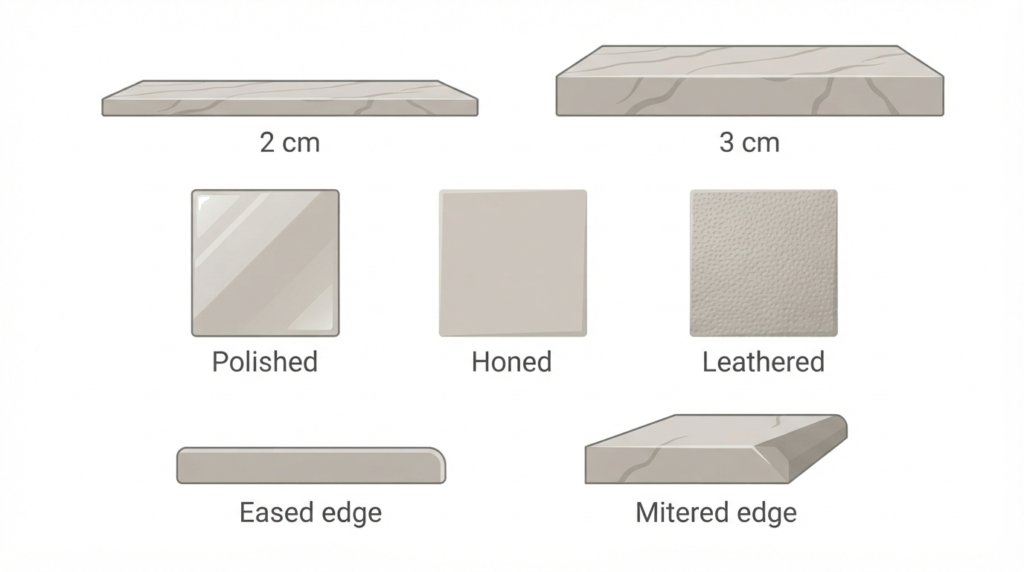
Thickness, edge and finish matter as much as the quartz vs granite countertops choice itself, and for most Bay Area kitchens a 3 cm slab with an eased edge in a finish that suits your water is the safest starting point. Here’s how the common options compare for both materials:
- 2 cm slab: Lighter and common in bathrooms or with a built-up edge. Common mistake: running a long 2 cm overhang without a plywood substrate or brackets.
- 3 cm slab: The kitchen standard, stiff enough to span cabinets on its own. Common mistake: assuming thicker means an island overhang needs no support.
- Polished finish: Shows the deepest color and wipes clean fast. Common mistake: choosing polished black in a hard-water home and fighting spots every week.
- Honed or leathered finish: Hides water spots and fingerprints well. Common mistake: forgetting that honed granite can absorb more, so it may need sealing more often.
- Eased edge: A softened square edge that resists chipping. Common mistake: picking a sharp, unsoftened edge in a busy kitchen where pots bump the counter.
- Mitered edge: Makes the slab look thicker at the front. Common mistake: forgetting that the miter is a seam that needs precise fabrication.
What Changes the Scope of Your Countertop Install?
The factors that shape your countertop project are mostly the same for both materials, and the slab itself is only one of them. When you line up quotes for quartz vs granite countertops, check that each one covers these items:
- Slab thickness and pattern: Heavy veining that has to flow across a seam takes more careful layout and sometimes more material.
- Edge profile: Mitered and decorative edges take more fabrication time than an eased edge.
- Cutouts: Undermount sinks, cooktops, faucet holes, soap dispensers and pop-up outlets each add work.
- Seams and layout: L-shapes, long islands and waterfall ends all change how many pieces are cut.
- Removing the old countertop: Tile set in a mortar bed takes much longer to remove than laminate.
- Access: Stairs, narrow side yards and steep hillside driveways in Orinda or Lafayette can mean a bigger crew on install day.
- Cabinet condition: Out-of-level or weak boxes need shimming, reinforcement or replacement before any stone goes on.
Quartz arrives with a predictable pattern. Granite asks you to walk the slab yard and choose your exact piece. Both paths work; they just take different kinds of time from you.
Our countertop installation guide explains how templating, fabrication and install day fit together, all handled by one in-house team. If your cabinet boxes are solid but the doors look dated, our guide on cabinet refacing breaks down how to update the fronts in the same project as your new stone. Ready to talk through your layout? Request your free quote here.
Where Each Material Makes Sense (and When It Doesn’t)
Quartz makes the most sense where low maintenance and a consistent look matter most, and granite makes the most sense where heat and sunlight are part of daily life. Real kitchens usually settle the quartz vs granite countertops question once you look at how they’re used.
Quartz is a strong fit when:
- You have a busy family kitchen in Concord where juice, coffee and tomato sauce hit the counter daily and nobody wants a resealing schedule.
- You want a bright white or soft gray island in Walnut Creek that matches the sample exactly, with no surprises across two slabs.
- You’re updating a rental in Fairfield and want a surface tenants can’t easily stain.
Granite is a strong fit when:
- You cook seriously in Danville and slide hot pans off the burner without thinking about trivets.
- Your kitchen in Martinez has a big west-facing window and the counter sits in strong afternoon sun for hours.
- You want one-of-a-kind movement in the stone and enjoy choosing your exact slab.
When quartz is not the best choice: outdoor kitchens, counters in all-day direct sun, and cooks who won’t use trivets. When granite is not the best choice: owners who won’t reseal, long islands that need a perfectly uniform pattern, and kitchens where you want a crisp solid white.
Countertops rarely change alone, either. Our kitchen remodel guide explains how stone choice fits with cabinets, layout and lighting when you’re redoing more of the room.
Example Project: Choosing Stone for a Hard-Water Kitchen in Vacaville
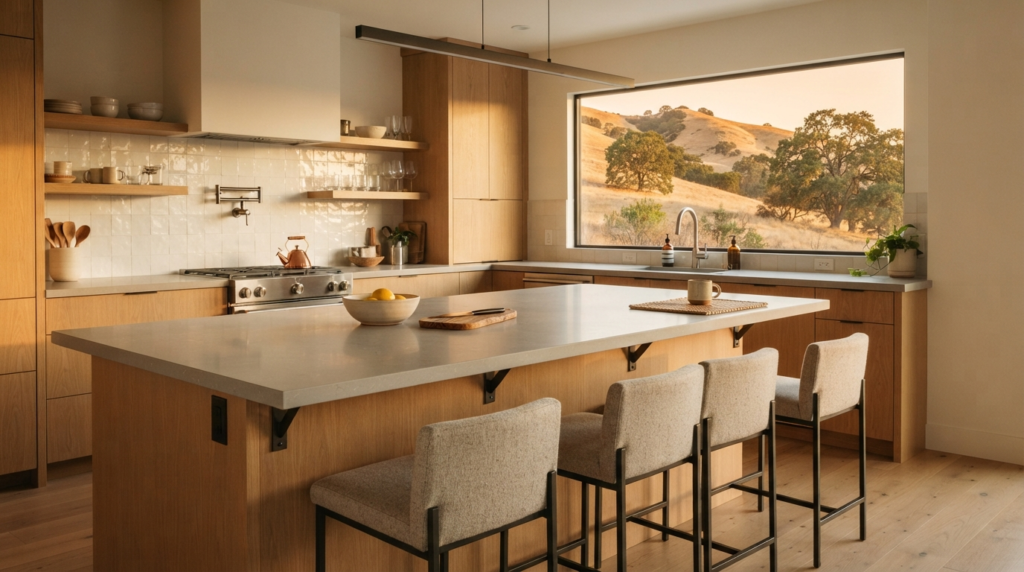
Picture a 1990s Vacaville kitchen with dark polished granite. The stone is sound, but the area around the faucet has a permanent cloudy ring, and the homeowners are tired of scrubbing. They check the city’s water quality report and find hardness around 10 grains per gallon, which explains the buildup.
For a case like this, we’d frame the quartz vs granite countertops decision as two honest options. Option one: keep a granite look, but choose a leathered finish that hides spotting and commit to resealing the sink zone. Option two: switch to a mid-tone quartz with soft veining, which needs no sealing and lets a damp cloth handle the film. Either way, the new layout would move the seam away from the sink, rod the sink rails, and add concealed brackets under the island overhang.
This is the kind of detail work homeowners mention in the 50+ five-star reviews we’ve earned across Google, Yelp and Thumbtack: attention to detail, clean job sites and a professional crew. You can read what people say on our Yelp business page or check our verified reviews on Angi. Adval Construction is licensed under CSLB #1059130, has completed 500+ countertop installations, and backs every install with a 5-year workmanship warranty.
Quartz and Granite Countertop FAQ
Is quartzite the same as quartz?
No. Quartzite is a natural metamorphic rock quarried in slabs, much like granite, while quartz countertops are engineered from crushed quartz and resin. Quartzite usually needs sealing and handles heat well, similar to granite. Quartz needs no sealing but is more sensitive to heat. When you compare quartz vs granite countertops, ask your supplier which one a slab really is, because the names get mixed up in showrooms.
Can you put a hot pan on quartz countertops?
You shouldn’t set a hot pan directly on a quartz countertop. The resin that binds the quartz can scorch, discolor or crack from sudden, concentrated heat. A trivet or hot pad solves the problem completely. If you regularly move pans straight from the burner to the counter, granite is the more forgiving side of the quartz vs granite countertops choice.
How often do granite countertops need to be sealed?
Most granite countertops need resealing every 1 to 3 years, though dense stones can go longer and light, porous ones may need it yearly. The easiest check is a water-drop test: if a few drops darken the stone within several minutes, it’s time to reseal. The area around the sink usually wears first. Quartz countertops never need sealing.
Why do white rings form around my kitchen faucet?
White rings around a kitchen faucet come from minerals in hard water, mostly calcium and magnesium, left behind when water evaporates. They show up on both quartz and granite, but they stand out more on dark polished surfaces. How hard your water is depends on your supplier, so check its annual water quality report. Drying the faucet area daily and using a pH-neutral cleaner prevents most buildup.
What affects the cost of quartz vs granite countertops?
The cost of quartz vs granite countertops depends on more than the material. Slab thickness, pattern matching, edge profile, number of cutouts, seam layout, removal of the old countertop, site access and cabinet condition all shape the final scope. Two quotes are only comparable when they list the same line items. A written, itemized estimate is the best way to compare.
What should you ask a countertop installer before hiring?
Before hiring a countertop installer, ask these questions:
- Is your contractor license active, and can I verify it with the CSLB?
- Do you template, fabricate and install in-house?
- Where will my seams land, and how will you support any overhang?
- How will you level and secure my cabinets before setting the stone?
- What does your workmanship warranty cover, and for how long?
Choosing Your Stone: The Next Step for Your Kitchen
The best countertop for your kitchen depends on three local realities: how hard your water is, how much heat and sun the counter sees, and how well the install handles a house that moves. Get those right and either side of the quartz vs granite countertops choice will look good for decades.
If you’re still weighing quartz vs granite countertops, let us bring samples to your kitchen, check your cabinets and give you a written, itemized plan. Schedule your free consultation or call us at (925) 278-8726. You can also see what homeowners say about our work on our HomeAdvisor profile.