
- Direct Answer
- Introduction
- Top Bathroom Remodel Trends Bay Area Homeowners Are Choosing in 2026
- Curbless, Spa-Style Showers Are Leading Every Trend List
- Warm, Organic Materials Are Replacing the All-White Look
- The 2026 Plumbing Rule Most Homeowners Don’t See Coming
- Large-Format Tile and Lower-Maintenance Surfaces
- Storage-First Vanities Built for Daily Life
- Shower System Options: A Quick Decision Guide
- Where Curbless Showers Make Sense, and Where They Don’t
- FAQ
- Walk-in shower vs. curbless shower: what’s the difference?
- Can you add a curbless shower to an upstairs bathroom?
- How often does large-format tile need resealing?
- Why do Bay Area bathroom remodels often take longer than homeowners expect?
- What factors affect the cost of a bathroom remodel in the Bay Area?
- What should you ask a contractor before starting a bathroom remodel?
- Conclusion
Direct Answer: Bathroom remodel trends Bay Area homeowners are embracing in 2026 include curbless walk-in showers, warm natural materials, large-format tile, and the water-efficient fixtures now required under California’s updated plumbing code, all reflecting a shift toward wellness-focused, low-maintenance design.
Introduction
If you’ve started researching a bathroom update, you’ve probably run into three terms that get used almost interchangeably: wet room, walk-in shower, and curbless shower. They’re not the same thing, and mixing them up can send your design in the wrong direction before you’ve even picked a tile.
You’re in the right place if you want a clear picture of what’s actually changing in bathroom design this year, not just a list of pretty photos. This guide covers three things: the specific bathroom remodel trends Bay Area homeowners are requesting most in 2026, a plumbing rule that catches a lot of people off guard once they pull a permit, and where these trends genuinely make sense for your home versus where they don’t.
You’ll also find a quick decision guide for shower systems and a comparison table you can use to sort through vanity storage options before you ever sit down with a contractor.
Top Bathroom Remodel Trends Bay Area Homeowners Are Choosing in 2026
Here’s the short version before we get into the details. These are the changes showing up most often in 2026 bathroom projects across Walnut Creek, Concord, Danville, and the rest of the Bay Area:
- Curbless, zero-threshold showers with a linear drain instead of a step-over curb
- Warm, textured materials like light oak, microcement, and earth-toned tile replacing stark white and gray
- Large-format tile with thinner grout lines for easier cleaning
- Storage-first vanities with deep drawers and built-in outlets instead of open shelving
- Water-efficient fixtures, which California now mandates on most permitted remodels regardless of your original scope
- Layered lighting, combining vanity task lighting with a secondary decorative fixture
Each of these shows up for a reason beyond style. Let’s look at why.
Want to see how any of these would actually look in your bathroom? Call Adval Construction at (925) 278-8726 or request a free estimate online, and we’ll walk the space with you before recommending anything.
Curbless, Spa-Style Showers Are Leading Every Trend List
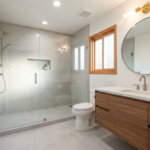
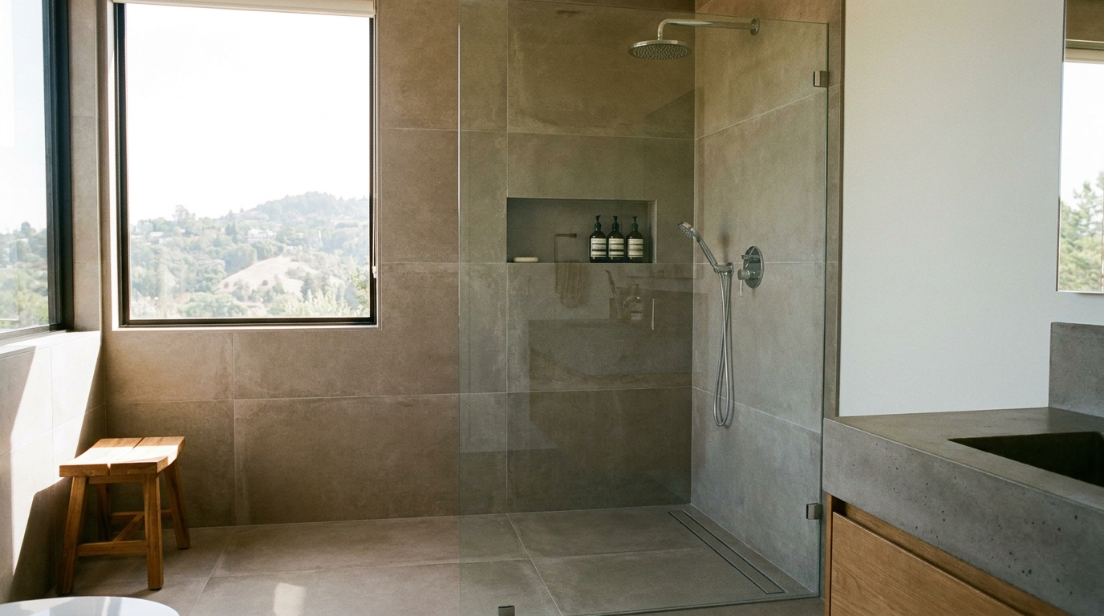
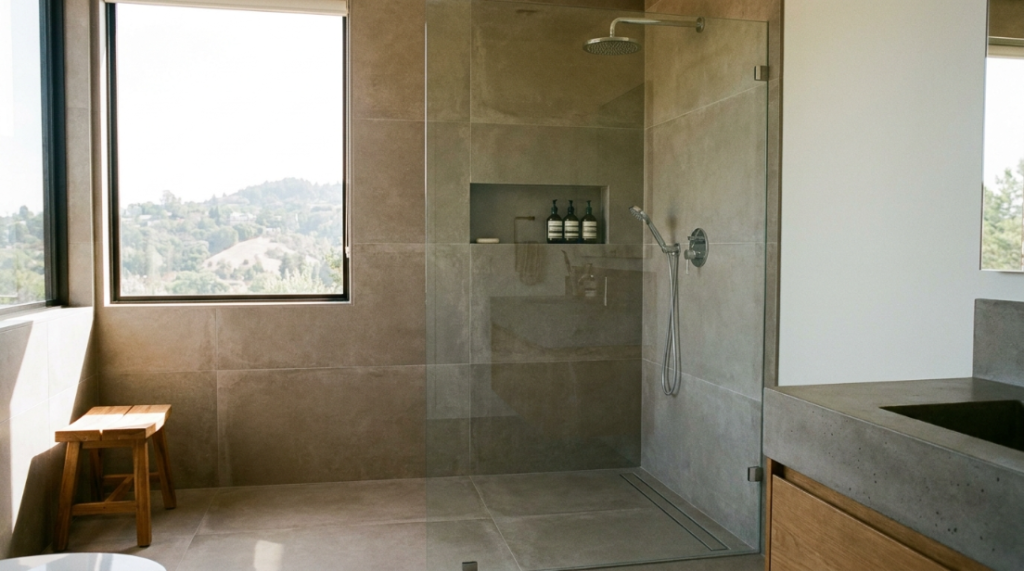
A curbless shower removes the step-over barrier and slopes the floor toward a drain instead, so the shower floor sits flush with the rest of the bathroom. It’s the single most requested layout change in bathroom remodels this year, and it’s driven by two separate groups of homeowners with the same request: people who want a cleaner architectural look, and people planning ahead for aging in place.
The most common footprint starts around 36 by 36 inches for a compact layout, with many 2026 projects targeting 48 by 36 inches or larger to fit a bench, dual shower heads, or body sprays comfortably. A linear drain along one wall, rather than a center drain, tends to work better with large-format tile because it reduces the number of angled cuts needed to slope the floor.
Frameless glass and doorless layouts pair naturally with this design. A framed shower door closes off the space. A doorless, curbless layout opens it up, and that difference is often what makes a small bathroom photograph and feel larger without moving a single wall. It’s one of the bathroom remodel trends Bay Area homeowners bring up most often when asked what they’d change about their old bathroom.
Warm, Organic Materials Are Replacing the All-White Look
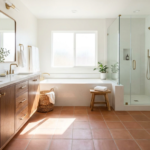
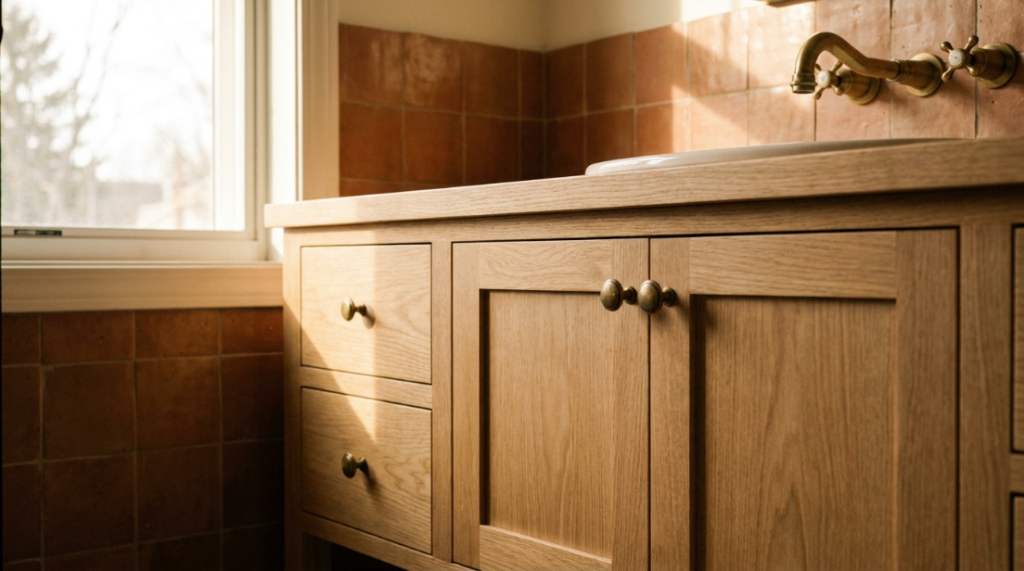
The all-white, high-contrast bathroom that dominated remodels for the past decade is losing ground fast. In its place, 2026 projects lean toward warm oak and walnut vanities, greige and terracotta tile, and textured plaster or limewash on the walls that don’t get wet.
Fluted glass and ribbed cabinet detailing show up often as a way to add texture without covering every surface in tile. Designers are also pulling back from tiling wall to wall, using a single feature tile inside the shower and a calmer, painted or plastered finish everywhere else.
This shift matters for resale, not just personal taste. A stark white bathroom photographs well for a single season of listings. A warmer, textured palette tends to read as more current for longer, which is one reason it’s become one of the more durable bathroom remodel trends Bay Area real estate agents mention to sellers preparing to list.
The 2026 Plumbing Rule Most Homeowners Don’t See Coming
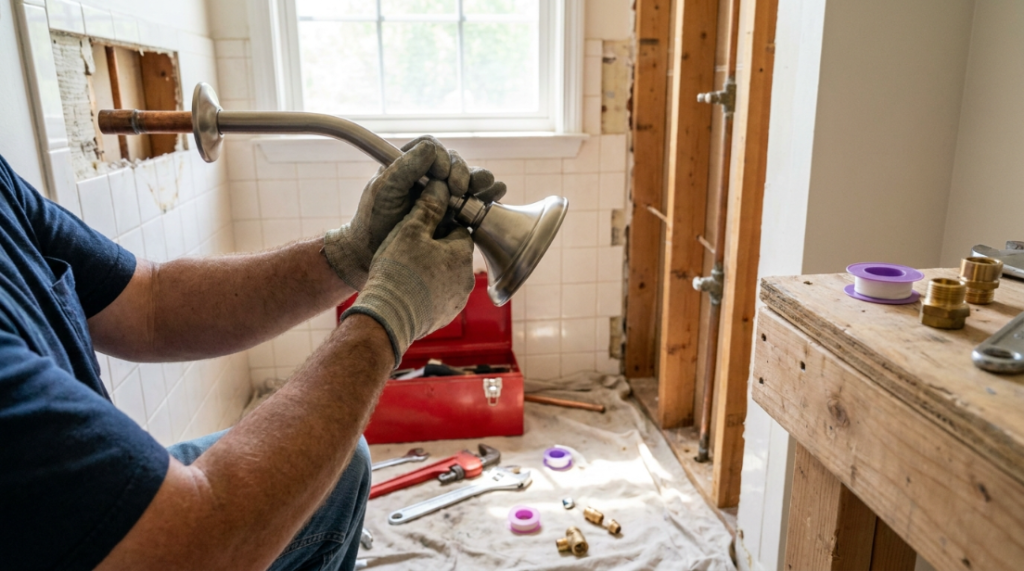
Here’s the part almost nobody mentions in a bathroom trends article, and it can genuinely change your project timeline or scope. It’s also the bathroom remodel trends Bay Area homeowners hear about least, even though it affects nearly every permitted project this year. Under California’s Civil Code and CalGreen 4.303, pulling a building permit for a remodel now triggers a requirement to replace non-compliant plumbing fixtures throughout the affected space, even ones you weren’t planning to touch.
In practice, that means a toilet rated above 1.6 gallons per flush has to be swapped for one rated at 1.28 gallons per flush or less. A showerhead pushing more than 2.5 gallons per minute needs to come down to 1.8 gallons per minute at 80 psi. Bathroom faucets are capped at 1.2 gallons per minute at 60 psi.
Here’s what that means for planning purposes:
- Budget for fixture replacement even if your “real” project is just the shower and tile
- Ask your contractor to confirm which existing fixtures in the room are non-compliant before demo starts
- Keep documentation of the certified low-flow fixtures installed, since inspectors will check model numbers against the state’s approved list
- Don’t assume a small cosmetic refresh skips this rule. It applies whenever a permit is required, not just for full gut renovations
Before you finalize a scope with any contractor, it’s worth asking directly: which fixtures in this bathroom currently meet code, and which ones does the permit require us to replace?
Not sure which of your fixtures the 2026 rules affect? Give our team a call at (925) 278-8726 and we’ll check before you commit to a scope.
Large-Format Tile and Lower-Maintenance Surfaces
Grout lines are shrinking. Industry trade surveys point to a strong shift toward tile with minimal or no visible grout, and toward large-format flooring taking over from smaller mosaic tile on the floor plane over the next few years.
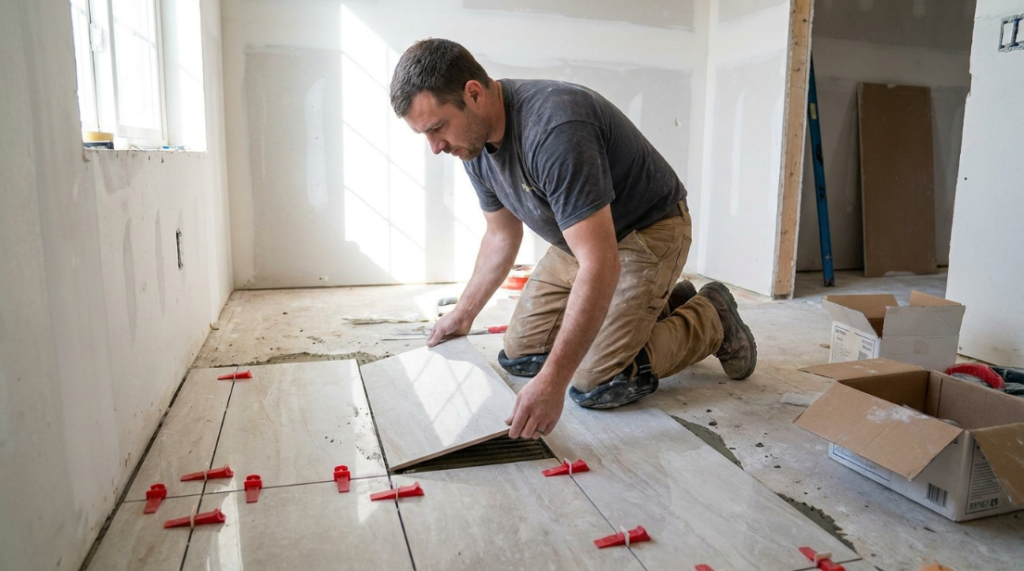
Larger tile, often starting at 12 by 24 inches and running up to 24 by 48 inches on floors, means fewer grout lines to scrub and fewer places for mildew to take hold. A small tile floor might have dozens of grout intersections. A large-format floor in the same footprint can cut that number down substantially, which is a real maintenance difference, not just an aesthetic one.
The tradeoff is installation precision. Large tile shows every imperfection in a subfloor that smaller tile can hide, so proper leveling matters more than it used to. This is one area where cutting corners on prep work shows up later as lippage or cracked grout, not right after installation, which is why it’s consistently one of the bathroom remodel trends Bay Area contractors flag as worth paying attention to during the estimate, not after tile is already set.
Storage-First Vanities Built for Daily Life
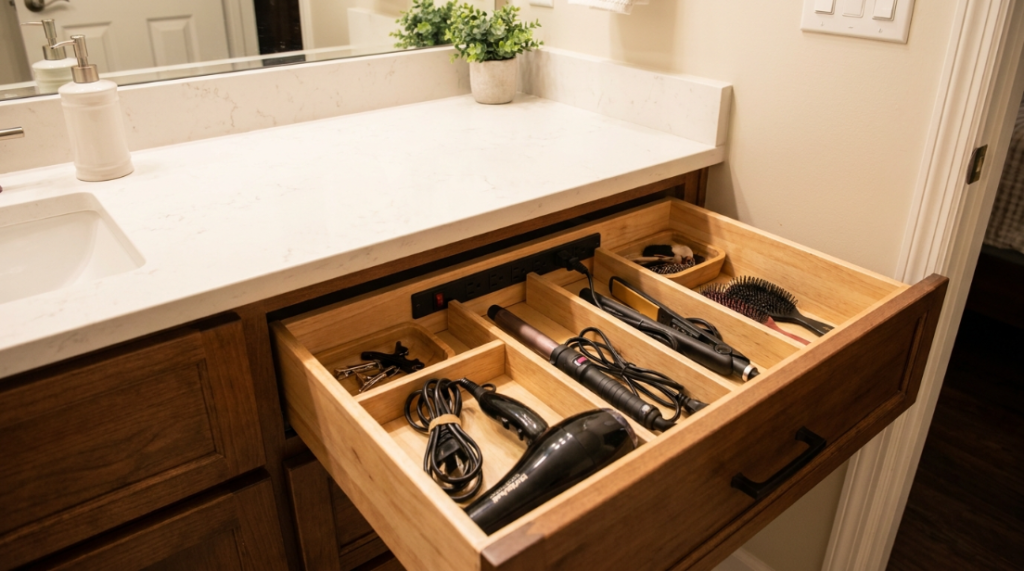
Open shelving had a moment, but 2026 vanities are going the other direction: deep, soft-close drawers, built-in outlets for hair tools, and completely clear countertops. Among the bathroom remodel trends Bay Area vanity showrooms report seeing most, this shift toward hidden storage is one of the clearest. The goal is a room that looks calm because the clutter has somewhere to live.
Here’s how the two most common vanity approaches compare for a typical primary bathroom remodel:
| Feature | Traditional Open Vanity | Storage-First Vanity |
|---|---|---|
| Countertop clutter | Common, since items need a visible home | Minimal, most items live in drawers |
| Charging and styling tools | Plugged into a wall outlet, cords visible | Built-in outlet inside a drawer, cords hidden |
| Drawer hardware | Standard glides | Soft-close glides and doors, standard on most 2026 projects |
| Best fit | Powder rooms with light daily use | Primary bathrooms used every morning |
Shower System Options: A Quick Decision Guide
Not every curbless or walk-in shower needs the same system underneath the tile, and this is where a lot of the bathroom remodel trends Bay Area homeowners see in photos start to differ from what actually gets built. Here’s what typically fits different situations:
- Linear drain systems: Best for large-format tile and doorless layouts, since the floor only needs to slope in one direction. Common mistake: placing the drain against the wrong wall, which forces awkward tile cuts everywhere else in the shower.
- Center point drain systems: A more traditional option that works well with smaller tile or mosaic floors. Common mistake: assuming this system is required for code reasons. It’s usually a design preference, not a requirement.
- Integrated waterproofing systems: Pre-formed benches, niches, and curbs with built-in waterproof membranes. Common mistake: skipping this in favor of standard cement board and liquid waterproofing, which can work but leaves more room for installer error.
- Thermostatic mixing valves: Maintain a set water temperature even if someone flushes a toilet elsewhere in the house. Common mistake: assuming any single-handle valve does this. Thermostatic valves are a specific, separate component.
Where Curbless Showers Make Sense, and Where They Don’t
Curbless design works best in single-story homes or primary suites where the contractor has room to recess the subfloor for a properly sloped pan. Many of the ranch-style homes common in Concord and Pleasant Hill are well suited to this, since the framing depth is usually there to work with. This is the piece of the bathroom remodel trends Bay Area homeowners in older neighborhoods most need to plan around before falling in love with a photo.
It gets more complicated upstairs. Second-floor bathrooms often sit on engineered floor joists with limited depth to drop the pan, and a curbless design there may require additional structural work that a standard walk-in shower with a low curb would avoid entirely.
Consider a typical situation our crews run into: a homeowner in a two-story home near downtown Walnut Creek wants a curbless shower in the upstairs primary bathroom, inspired by a photo from a single-story home. Once we open the floor, the joist depth doesn’t leave enough room to slope a curbless pan without dropping the ceiling in the room below. In a case like this, a low-profile curb, often just three-quarters of an inch, delivers a similar look and the same easy step-in feel without touching the structure below.
Where curbless design doesn’t make sense: bathrooms directly above finished living space with limited joist depth, and situations where a homeowner wants the look purely for resale value on a home they plan to sell within the year. In both cases, a low-curb or standard walk-in shower usually delivers a comparable result with less construction risk.
It’s a good reason to reconnect with the reviews Adval Construction has collected from Bay Area clients. Across our Google Business Profile, Yelp page, and Thumbtack bathroom remodeling profile, the recurring theme in that feedback is less about any single design trend and more about communication: homeowners consistently point to clear explanations of tradeoffs like this one, before demo starts rather than after.
Frequently Asked Questions
Walk-in shower vs. curbless shower: what’s the difference?
A walk-in shower simply has no door, but it can still have a small curb at the entry. A curbless shower removes that curb entirely and slopes the floor to a drain, so it sits flush with the rest of the bathroom. This distinction is one of the first things to sort out when comparing bathroom remodel trends Bay Area homeowners bring up in early conversations with a contractor. Every curbless shower is a walk-in shower, but not every walk-in shower is curbless.
Can you add a curbless shower to an upstairs bathroom?
Sometimes, depending on the depth of the floor joists below the bathroom. If there isn’t enough room to slope a pan without lowering the ceiling underneath, a low-curb walk-in shower is usually the more practical alternative. A contractor typically needs to open the floor to confirm joist depth first.
How often does large-format tile need resealing?
Porcelain tile itself doesn’t need sealing, but natural stone versions typically need resealing every 12 to 24 months depending on traffic. Grout, even the thinner lines common with large-format tile, generally benefits from a yearly sealant refresh in a shower. Water beading on the surface is a simple way to check if it’s time.
Why do Bay Area bathroom remodels often take longer than homeowners expect?
The biggest factor is usually what’s found once demolition starts, particularly in older homes where original plumbing or framing doesn’t match current code. Permit review and inspection scheduling with local building departments adds time on top of construction. This is one of the bathroom remodel trends Bay Area homeowners rarely see coming until it’s already their project. Backordered tile, vanities, or fixtures can push a timeline further, which is why a realistic schedule builds in buffer time.
What factors affect the cost of a bathroom remodel in the Bay Area?
Layout changes matter most: relocating fixtures or removing a tub takes more labor than keeping the existing footprint. Material choices, from tile format to vanity construction, create a wide range depending on what’s selected. The condition of what’s behind the walls in older Bay Area homes also plays a role. A room-specific estimate is the only reliable way to understand these factors for your bathroom.
What should you ask a contractor before starting a bathroom remodel?
Ask which existing fixtures the 2026 water-efficiency rules will require you to replace, since that affects scope and timeline. Ask for their current CSLB license number and confirm it against the state’s records. Ask how they handle unexpected findings behind the walls, in writing. Ask for examples of projects in your specific city, since the bathroom remodel trends Bay Area contractors see in older Walnut Creek or Concord homes differ from what newer construction requires.
Conclusion
The bathroom remodel trends Bay Area homeowners are choosing in 2026 share a common thread: less visual clutter, more durable materials, and design decisions that hold up over years, not just for one round of photos. Curbless showers, warm natural finishes, and storage-first vanities all point in that direction, and the water-efficiency rules baked into this year’s permits are worth planning around from day one rather than discovering midway through demo.
If you’re weighing these trends against the realities of your own bathroom, especially an older home in Walnut Creek, Concord, or anywhere else in Contra Costa or Solano County, our bathroom remodeling service page breaks down what a full renovation typically includes. You can also browse recent finishes and layouts in our project gallery before you settle on a direction.
Ready to talk through what makes sense for your specific space? Call us at (925) 278-8726 or reach out to our team online, and we’ll walk your bathroom with you before recommending anything.